
Learner Identity

Some philosophers make a a key distinction between value and values. Value refers to the relative utility of an object, whereas values refers to the behavioural disposition of a person or social group. In the former category, it might seem strange to include such diverse items as the beautiful River Spey, which runs closely past my window, or the evening canticles in A major by Charles Stanford which I look forwards to singing at evensong. It is possible in both cases to quantify how much others and I value these. They therefore have value. In contrast, the disposition to treat all people equally regardless of any attribute of identity is one of my personal values and we would probably not think of evaluating it as a quantity, though we could evaluate the truth of my claim to value equality by observing and recording how I actually treated people. Not long after I moved from a boys' choir school to teach in the state sector I became disturbed to find that significantly more boys than girls appeared not to value schooling, a phenomenon that was new to me. The result of this was readily quantifiable in the statistics of classroom disruption, exclusions, exam results and male violence. These suggested that there was a “problem with boys” and it was a problem I wanted to get to the bottom of.
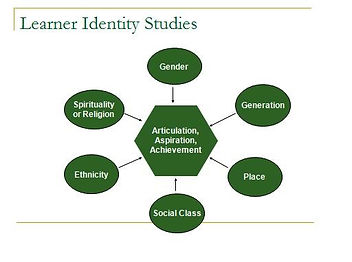
I took with me this understanding to Edge Hill University where I founded and directed CLIS, the Centre for Learner Identity Studies. The point of this diagram is to show that though discrete categories of identity such as gender can usefully be studied in great depth, no single one of them gives a complete and holistic picture of the individual or indeed the social group with which the individual is associated. For example, a single focus on gender with no reference to social class can render invisible white, working-class girls. Whilst “hegemonic masculinity” was undoubtedly a factor, teacher expectations was the principal explanation for boys’ absence from a dance group. There may well be more than six discrete categories but to my mind, we will never understand boys’ underrepresentation in singing or girls’ underrepresentation in technology and science unless we keep in mind the principle that multiple factors interact to create the identities that say “I am a singer” or “I am a physicist”.
Attachment Behaviour -The Theory
The existence of so many neglected and unloved children is a major challenge to our views on the value of childhood. A seminal contribution in this field is John Bowlby's attachment theory. Peer Attachments and Social Deviancy in the Primary School drew on this theory to demonstrate the extent to which the lack of a secure bond at school might be associated with "bad behaviour". I had originally hypothesised that the necessary bond would be with the teacher, one reason for primary school children being allocated a familiar class teacher rather than being expected to cope with different subject teachers. My research demonstrated that teachers were not attachment figures and questioned the need for class generalists beyond Key Stage 1. What mattered was not bonding with a teacher as a substitute parent but attachments to peers. The "problem with boys" was strongly associated with either no attachments to peers, or strong attachments to sub groups with values opposed to those of the school.

Key Publications
1992 The validity of sociometric status, Educational Research, 34(2):149-154
1993 Peer attachments and Social Deviancy in the Primary School. Unpublished MPhil thesis, University of the West of England, Bristol.
1999 Toys for the Boys, whilst the girls learn science and technology, School Science Review, 81 (295), 29 – 34.
2000 Secular spirituality and implicit religion: The realisation of human potential?, Implicit Religion, 3 (1), 31 – 49.
2001 Spiritual development: Whose responsibility is it anyway? In U. King (ed.), Spirituality and Society in the New Millennium. Brighton: Sussex University Press, 151 – 162.
2003 Women Teaching Boys: Caring And Working in the Primary School. Stoke-on-Trent: Trentham Books.
2002 Singing, gender and health: perspectives from boys singing in a church choir, Health Education, 102 (4).
2006 Primary School Boys’, Identity and the Male Role Model: An Exploration of Sexual Identity and Gender Identity in the UK Through Attachment Theory, Sex Education, 3 (3) 257 - 270.
2007 with Nicholson, M. What makes a pedagogy fit for key stage two? In P. Harnett, (ed.), Understanding Primary Education: developing professional attributes, knowledge and skills. London: Routledge, 54 - 70.
2008 Teaching Singing to Boys and Teenagers: The Young Male Voice And the Problem of Masculinity Lampeter/Lewiston/New York: Edwin Mellen Press.
2008 Boyhood melancholia and the vocal projection of masculinity, THYMOS: Journal of Boyhood Studies, 2 (1), 26 – 35.
2009 Time to Confront Willis's Lads with a ballet class? A case study of educational orthodoxy and white working-class boys, British Journal of Sociology of Education, 30 (2): 179 – 191.
2010 The perpetuation of hegemonic male power and the loss of boyhood innocence: case studies from the music industry. Journal of Youth Studies, 14 (1): 59 – 76.
(2010) Slappers who gouge your eyes: Vocal performance as exemplification of disturbing inertia in gender equality, Gender and Education, 22 (1): 47-62.
2010 “Real boys” don’t sing, but real boys do: the challenge of constructing and communicating acceptable boyhood, THYMOS Journal of Boyhood Studies, 4 (1), 54 – 69.
2012 Do boys need ‘Lads and Dads’? Interventions to increase resilience in the face of educational failure Keynote and seminar paper for Visiting Professorial Scholarship to University of Queensland, February 2012.